Decision Quality
ECC Lens: Criteria
Discounting Under Pressure: Whose Problem Does It Solve?
Many late discounts are not commercial decisions. They relieve the seller’s own pressure. How to tell the difference, and when moving on price is right.
By Adrian Feder · · 7 min read
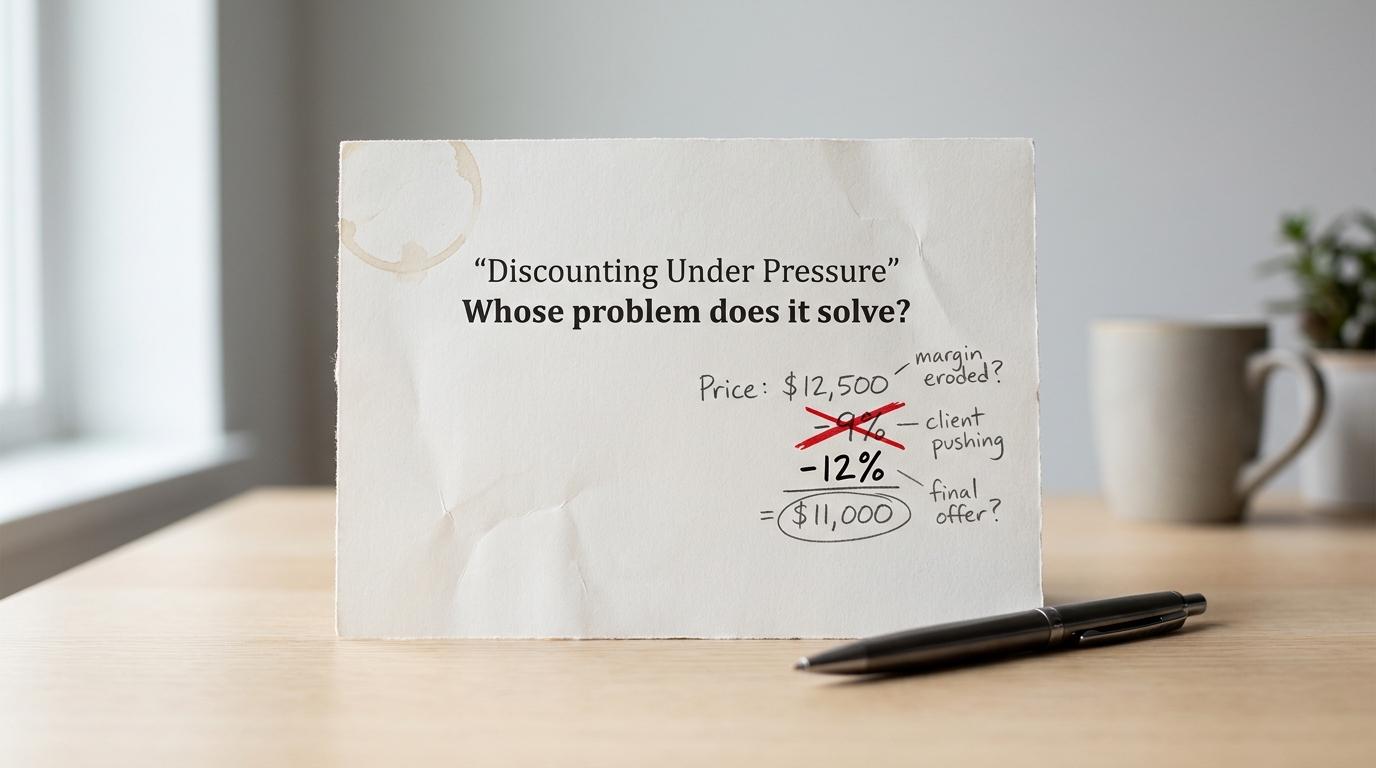
I once prepared a nine per cent discount for a customer who had not asked for one.
It was an automotive customer, in my first company, and they had gone quiet for three weeks. Before I picked up the phone I had already decided what I was going to offer. I had worked out the figure, checked that it was within what I could approve and prepared the sentence. They had not requested a reduction. They had not said anything at all, which was the reason I was calling.
At the time it felt like initiative. I was working harder that quarter than I had ever worked, my activity numbers were excellent, and anyone who saw only my report would have said I was having a good year.
What I understand now is less flattering. I had been carrying that account for four months. The quarter was gone without it. The silence had become more expensive for me than it was for the customer. So I paid to end it, with money that belonged to the company, before the customer had asked for anything.
That was not generosity and it was not weakness. It was relief. I have come to think that a good deal of discounting in B2B sales, particularly the late kind, works the same way: it solves a problem the seller has, not one the customer has.
The discount nobody asked for
The nine per cent was not an isolated case. On another opportunity I had eight months of technical work behind it: three site visits, a test plan that had been through four revisions and a champion who had defended the programme internally twice. Then, on a Tuesday, an email arrived from somebody I had never spoken to, in a department I had not dealt with once. Please send a revised proposal by Friday. No explanation of what was wrong with the current one.
I sent it by Thursday, with a discount nobody had asked for.
I did not ask what they were evaluating. I did not ask what was behind the Friday deadline, or whether they were comparing equivalent scope. The email had frightened me, and reducing the price was the fastest available way to stop feeling frightened. I answered a question that had not been asked, and I paid for the privilege.
What the large programmes taught me
Every couple of years in my industry, testing and certification, a programme appears at a completely different scale from ordinary business. It runs for years and changes what a year looks like if you win it.
Since 2005 I have competed for around ten of them. I have won one. The rest went on price. On several of them we discounted heavily and adjusted parameters to bring the figure down, and we lost anyway.
There are two ways to read that, and I do not know which applies to which programme. The comfortable reading is that some of them were price competitions from the beginning. That happens, and no amount of relationship changes it. The uncomfortable reading is that when the only lever left is the number, the value was never established with the people who ended up deciding. By the time we were shaving percentages, we were negotiating against ourselves inside a conversation that had already been lost somewhere upstream.
What I can say without ambiguity is that discounting late has never once won me one of those programmes.
The one I did win ran for several years and we delivered it to the end. It was won on a structure we could sustain.
Value has to survive translation
When a technically complex programme suddenly becomes entirely about price, it is tempting to blame purchasing. Sometimes that is fair. Often the vulnerability was created much earlier, by us.
If nobody has helped the customer put into words why one approach carries less risk, or why particular parts of the scope matter, purchasing receives proposals that look broadly equivalent and concentrates on the difference it can measure.
Value has to survive translation between stakeholders. The people it must reach were not in the meetings where it was created. A technical contact who prefers your solution but cannot explain why when the cost is challenged has not finished the job with you. It only felt finished, because the person in front of you already agreed.
So the most useful question about price is asked months before the price conversation, of that technical contact: “When this goes to purchasing, what will they be looking at beyond the number?” Sometimes the honest answer is that price will dominate. That is not a bad answer. It tells you what kind of opportunity this is while you can still decide how much of your quarter to build on it.
A concession is a trade
The most useful negotiating discipline I have learned is to stop treating concessions as isolated acts of goodwill. If a customer asks, there is margin available and I simply agree, the customer learns that asking produces movement and nothing needs to change on their side. In a business where the same customer returns with every new part, that lesson lasts for years.
A commercial package usually holds more than the headline figure. Before moving, I now ask whether the real issue is the total cost, the cash timing, the flexibility or the risk exposure, because each needs a different answer:
- If the problem is this year’s budget, phasing the programme solves it better than a discount.
- If the problem is uncertainty about future volume, a different commitment structure serves both sides.
- If part of the scope has limited value to the customer, adjust the scope.
- If the price does move, something else becomes firmer: volume, duration or payment terms.
Where several trade-offs are possible, two or three coherent options work better than revising one proposal indefinitely: a contained one, the one you recommend and a broader one. Each must differ in something real. Three prices attached to the same thing only teach the customer that your pricing is arbitrary.
This also changes the internal conversation. A salesperson asking for approval can say what the company receives in return. The concession becomes a commercial decision instead of a transmission of pressure.
The economics and the calendar
None of this means never discount. Price is a legitimate subject, and sometimes reducing it is simply the right decision. A major strategic opportunity may warrant a different margin. Additional volume or a longer commitment changes the economics. Sometimes revenue timing is a legitimate part of the context too, and a company may reasonably accept lower margin for it.
What matters is that the reason is visible. The question I use takes a few seconds: would this concession look equally attractive if I were already comfortably above target? The answer does not settle whether the discount is right. It separates how much of the decision comes from the economics of the opportunity and how much from the discomfort of the calendar.
This is what I mean by Criteria, the third element of ECC alongside Energy and Clarity: knowing what you decide by when there is no clean answer. It does not guarantee the order. It makes it more likely that when I move, I know why.
This week
If you sell: before your next concession, write down what it is intended to change. Does it resolve the obstacle, or is another approval still required afterwards? What does the customer give in return? If the honest answer is because I am afraid they will say no, look again before you send it.
If you manage: a team can be authorised to give away margin and yet not to spend three weeks establishing value with the people who will decide on price. Check which of the two your approval process makes easy. The next time someone requests a discount approval, ask what the concession is intended to change. And if you accept lower margin for quarter-end reasons, say so plainly.
This article draws on Selling From Within (2nd edition). The Selling From Within Diagnostic at selling-from-within.com shows where your own Energy, Clarity and Criteria currently stand.
Share this article
Enjoyed this article?
Subscribe to the Selling From Within Journal for new articles, practical templates and resources for better B2B sales decisions.
No spam. By subscribing, you agree to receive the Selling From Within Journal. You can unsubscribe at any time. See our Privacy Policy.
Go Deeper
Explore the ideas in Selling From Within or see how you currently operate under commercial pressure.